
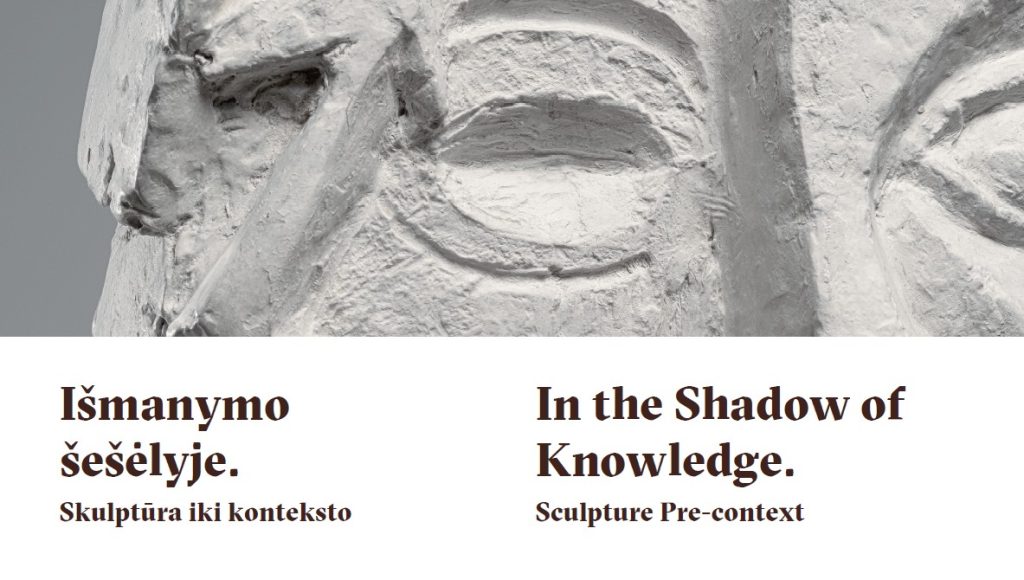
The eighth TARTLE exhibition – In the Shadow of Knowledge
“We also hold what resides in the shadow of knowledge,” remarked Vladas Urbanavičius, one of Lithuania’s most renowned sculptors, in conversation with the art critic Alfonsas Andriuškevičius. This idea defines the concept of the exhibition, which presents sculpture as a direct, sensory experience. Sculpture in the shadow of knowledge invites viewers to encounter sculptural objects before contextualizing their themes or meanings. Here, the emphasis is on the intrinsic properties of sculpture – its spatial presence, materiality, and emotional impact – elements we perceive immediately, before engaging in rational analysis and starting to “read” the work like a book. The exhibition unfolds in three sections: space, material, and dream. It features works from the TARTLE collection, spanning the 19th to the 21st centuries, with a strong focus on classical and modernist Lithuanian sculpture. Complementing these pieces are contemporary sculptures from artists’ private collections, which challenge tradition and invite new ways of seeing – offering moments of surprise and discovery.
Space. Space is one of the most fundamental aspects of sculpture. This exhibition explores both public and private space, showcasing models of sculptures designed for public settings alongside small-scale works intended for more intimate environments.
Material. Sculpture is an art of materials. Material defines a sculpture’s authenticity; it is, in a sense, its mother. This exhibition highlights the importance of materiality through key sculptural mediums such as stone and wood, alongside what could be called “liberated assistants” – gypsum, chamotte, terracotta, and plastic.
Dream. In this exhibition, modernist sculpture enters into dialogue with contemporary works, where both space and material are in flux. The scale and proportions of objects shift, as does their relationship with the viewer, and familiar materials transform. Here, known rules no longer apply – we enter a realm of premonitions, emotion, and experience, where rational knowledge gives way to shadow, subconsciousness, and dream.
In the Shadow of Knowledge invites visitors to approach sculpture intuitively, discovering what might otherwise go unnoticed. Featuring over 70 works, the exhibition brings together some of Lithuania’s most celebrated sculptors from different eras – Mark Antokolsky, Jacques Lipchitz, Petras Rimša, Vladas Mikėnas, Antanas Mončys, Ksenija Jaroševaitė, Vladas Urbanavičius, and Mindaugas Navakas – alongside contemporary artists such as Nerijus Erminas, Andrius Erminas, Marija Šnipaitė, Tauras Kensminas, and Mykolas Sauka.
Curator
Doc. dr. Jurgita Ludavičienė
Architects
Doc. Aušra Siaurusaitytė Nekrošienė, Agnė Makariūnaitė (UAB „Vilprojektas“)
Graphic designer
Daiva Sakalauskienė
Photo credits
Antanas Lukšėnas, Jonas Balsevičius
About the opening of the exhibition, exposition, and its exhibits:
-
-
- LRT klasika „Skulptūrų parodose – masažas medžio gumbui, skambantys vamzdžiai, medžiagos meistrystė“:
-
-
- Verslo žinios „Išteisinamasis žodis skulptūrai. Pokalbis vienos parodos kontekste“: https://www.vz.lt/verslo-klase/2026/04/03/isteisinamasis-zodis-skulpturai-pokalbis-vienos-parodos-kontekste-582384
- Panorama: https://www.lrt.lt/mediateka/irasas/2000420591/lietuvos-meno-pazinimo-centre-tartle-paroda-dedikuota-skulpturos-zanrui
- Laba diena, Lietuva: https://www.lrt.lt/mediateka/irasas/2000420545/laba-diena-lietuva
- bernardinai.lt: https://www.bernardinai.lt/menas-kuris-visada-bus-tarp-zmoniu-tartle-parodoje-intuityvus-zvilgsnis-i-skulptura/?fbclid=IwY2xjawLkM49leHRuA2FlbQIxMQABHkJDMvkvRh4FZznbHTUNSIfNnTwbRRFGeH8bHrg00I9rKY8aunv9lCRe1sgg_aem_rCkSpQMStVMSV1zjUyG_8Q
- Delfi: https://www.delfi.lt/veidai/zmones/vilniuje-atidaryta-isskirtine-paroda-patrauke-ir-zinomu-zmoniu-demesi-120115986
- 15min.lt: https://www.15min.lt/zmones/naujiena/lietuva/vilniuje-isskirtine-paroda-kalbanti-skulptura-ir-rolando-valiuno-sukviestas-meno-gerbeju-elitas-1050-2464908
- Verslo žinios „Išteisinamasis žodis skulptūrai. Pokalbis vienos parodos kontekste“: https://www.vz.lt/verslo-klase/2026/04/03/isteisinamasis-zodis-skulpturai-pokalbis-vienos-parodos-kontekste-582384
-
-
read more
Mindaugas Navakas (b. 1952)
Untitled, 1977-1978
Space
Space is the first element through which we perceive sculpture. A sculpture not only occupies space but also creates it as we approach it. Often, space becomes an inseparable part of the work — making sculpture more than a tangible object. It also involves what cannot be touched or easily shown, and is even harder to capture visually. Yet this presence is always felt in real life — in the direct experience of sculpture. This exhibition explores the spatial experience of sculpture through two key dimensions: public space and private space.
Public space
Sculpture in an open space engages the viewer through three key qualities: monumentality, mass, and scale. Each of these interacts with space in a unique way, shaping a distinct experience for the observer. Scale, in particular, defines a sculpture’s intent — the way we relate to space and to the human body changes entirely when confronted with a towering monument versus a small figurine on a pedestal. This section of the exhibition brings both aspects into dialogue by presenting small-scale models of sculptures designed for public spaces.
Monuments must be visible, impressive, and grand. Yet behind each public sculpture often lies a smaller counterpart — a model. These models, though modest in size, precede the final work and represent the sculptor’s initial ideas. They are complete artworks in their own right, serving as a testing ground and a record of the sculptor’s thought process. This exhibition not only showcases these models but also allows viewers to compare them with the completed sculptures, presented through photographs in their real-life settings.
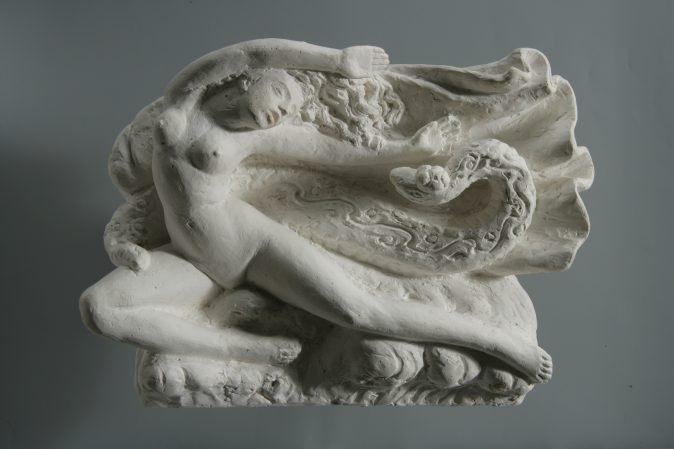
Robertas Antinis’ Sr (1898–1981)
Eglė, the Queen of the Serpents, 1957
The theme of Eglė, Queen of the Serpents is one of the central motifs in the work of Robertas Antinis’ Sr (1898–1981). The sculptor first exhibited a relief depicting Eglė in 1935 at the First Autumn Art Exhibition in Kaunas. The theme reappeared in reliefs made by him in 1941, 1944, 1947, 1955 and 1958, in a round sculpture in 1957, and finally in the famous sculpture in Palanga Park in 1958. All these works capture the same moment: Eglė is recoiling in fear after finding a snake in her blouse. Another compositional variation of Eglė holding a crown high, with a serpent coiled around her legs, is much more static. The plaster relief of 1957 demonstrates the sculptor’s desire to express Eglė’s fear and surprise at finding the serpent. This is conveyed through her expressively depicted hands, which, along with the folds of her clothes, the curls of her hair, and the coils of the snake’s body, create a restless, undulating and powerful impression. Antinis chose for the Palanga Park sculpture an even more expressive and dynamic version. Eglė is depicted balancing on one leg, with the other leg thrown out to the side and a garment flying over her head in an arc. The sculpture’s controlled volumes and expressive lines express the moment of surprise and fright.
Text author Jurgita Ludavičienė
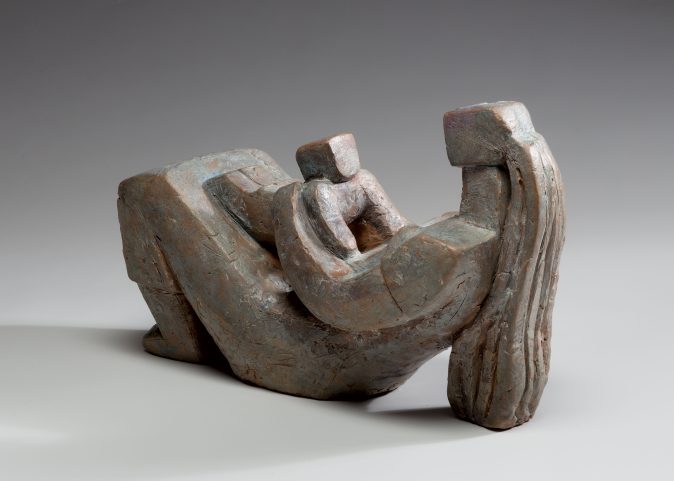
Jadvyga Mozūraitė-Klemkienė (1923–2009)
Mother and Child, 1988
The theme of motherhood has been a prominent element in the sculptor’s work throughout her career. The rich, abstracted lines of the woman’s body and the accentuated female silhouette reflect Jadvyga Mozūraitė-Klemkienė’s (1923–2009) respect for women as bearers of life and as creators. Her studies at the State School of Midwives (1941–1943) and her subsequent work as a midwife at Kaunas University Clinic (1943–1946), along with her unrealised experience of motherhood, probably influenced this interest. In both her sculptures and her linocuts, Mozūraitė-Klemkienė created monumental portraits of women and children, with round, sensitively modelled forms, expressing respect for motherhood, tenderness, and the unity of a mother and her baby. Notable works include Family (Mother) (1965–1966), Family (1966), and Mother and Children (1968). Mother and Child, a terracotta sculpture, was later repeated on a large scale in granite in 1973 and now stands in Kaunas near the Obstetrics Clinic. The same arrangement of a mother cradling and rocking her child can be seen in a later terracotta sculpture. In this version the details differ: the lines of the body are straighter and more angular, and the mother’s long hair reaches down to the ground, serving as an additional counterweight to the body.
Text author Jurgita Ludavičienė
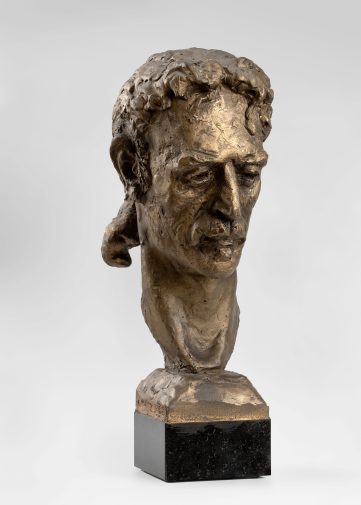
Konstantinas Bogdanas Sr (1926–2011)
Frank Zappa, after 1995
Konstantinas Bogdanas Sr (1926–2011) is one of the most famous Soviet Lithuanian sculptors, awarded as an artist of merit, a winner of the State Prize, a deputy in the Supreme Council of the Lithuanian Soviet Socialist Republic, chairman of the Lithuanian Artists’ Association, and vice-rector of the State Art Institute. Remarkably, he also created a bust depicting Frank Zappa, the controversial American avant-garde musician. The history of this monument, which has no direct connection with Vilnius, is shrouded in mystery, a fitting characteristic, given that the idea’s originators, Saulius Paukštys and Ernestas Parulskis, actively created and spread these myths. It began with a fictitious meeting between Paukštys and Zappa during Paukštys’ visit to the USA in 1991. The idea subsequently arose to put up a monument to Zappa in Vilnius, and it was decided to commission Bogdanas, who was widely recognised and awarded for his Soviet-era sculptures, particularly his images of Lenin. Bogdanas agreed to carry out the project. Initially, the sculpture was to be placed beside the M.K. Čiurlionis School of the Arts, but the school administration later rejected the idea. A new location was found on K. Kalinausko Street, where the bust was unveiled in 1995 and remains to this day. Later, a small bronze replica of the bust was sent to Baltimore, Zappa’s home town in the USA, and several replicas (the exact number is unknown) were made in epoxy resin.
Text author Jurgita Ludavičienė
Views of the exposition
Private space
A work of art in a private space carries a special presence. Having a sculpture at home means living with something eternal and real. Once placed in a personal setting, small-scale sculptures become part of everyday life. Their material presence — one of sculpture’s most important and (perhaps) compelling qualities – remains intact even in the intimacy of a home. Unlike public monuments that commemorate collective events, small sculptural forms often reflect personal ideas, inner thoughts, or imaginative experiments. They can feel like three-dimensional short stories or sculptural poems. One of the most common materials for such works is bronze – an alloy of copper and tin (sometimes with other elements). Bronze is strong, durable, and plastic; it can be cast into detailed forms and volumes, offers a rich palette of colours and patinas, and invites touch with its textured surface. These qualities have made bronze a favoured sculptural material since the Bronze Age.
The sculptures in this bronze collection are primarily examples of small-scale sculpture, a format that fosters an intimate, personal connection with the viewer. Whether anthropomorphic or abstract, these works — close to the scale of the human body — invite us to become part of the narrative they suggest.
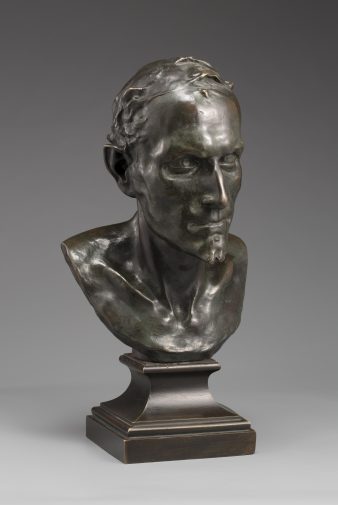
Mark Antokolsky (1843–1902)
Head of Mephistopheles, 1879
The figure of Mephistopheles, a fallen angel or demon, originated in German folklore and literature. The most famous depiction of this malign character is in the tragedy Faust by Johann Wolfgang Goethe (1745–1832). Mephistopheles was later portrayed by many writers of the Romantic era from various countries, including Adam Mickiewicz. The character is easily recognisable, not only by the distinct traits of his personality, but also by his angular face, his sharp nose and his pointed beard. The highly talented Jewish sculptor Mark Antokolsky (1843–1902) created a version of Mephistopheles that adheres to this established canon.
One of the most renowned sculptors of the late 19th century, Mark (born Morduk) Antokolsky was born in Vilnius, where Marko Antokolskio Street now honours his memory. He owed his early artistic education to Vilnius, where he received his first lessons, and to Rafal Slizien, a graduate of the Vilnius Art School, who supported his later studies. After completing his education in St Petersburg, he settled in Rome, but returned to Vilnius briefly to marry a local woman. Although he achieved significant professional success in Russia, becoming a professor and a member of the St Petersburg Academy of Fine Arts, he moved to Paris permanently in 1877. He became an honorary member of the Paris, Berlin and Urbino art academies. He died in Hamburg, and was later reinterred in the St Petersburg Jewish cemetery.
Antokolsky’s creative legacy is huge and diverse, including portraits, memorial sculptures and monuments. His monument to Catherine II in Vilnius, completed after his death and dismantled in 1915, deserves a special mention. However, his most famous and widely recognised work is perhaps his depiction of Mephistopheles. The theme of Mephistopheles appeared in his work in the mature stage of his career, after he began creating a figure of Christ in Paris in 1877. Mephistopheles was intended to be the antithesis of Christ. The bronze bust Mephistopheles, cast in 1879, was a study for a future full-figure sculpture. The sculpture became so popular that it was reproduced as an independent work. This version of the work can nowadays be seen in many museums around the world. Antokolsky made a head of Mephistopheles from white marble in 1880, and in 1883 he completed a full-figure marble image of the demon. He wrote in a letter: ‘Mephistopheles is a product of all eras, especially our own. You might say that I invented his presence, that he is just a figment of my imagination, or you could ask where I encountered such a being. It is true that no one has seen him in this form, but we can feel his breath, his huge hand pressing down on our chest, and our inability to cry. In a word, we experience a nightmare.’ Antokolsky expressed skilfully the complex, paradoxical nature of the creature in the demon’s face, which, according to Goethe, is ‘part of that power which eternally wills evil and eternally works good.’
Text author Rūta Janonienė
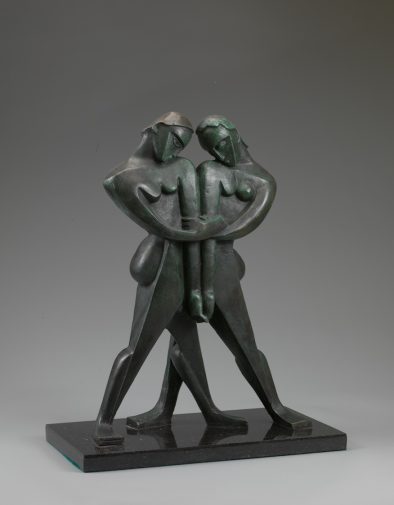
Jacques Lipchitz (1891–1973)
The Encounter, 1913
The world-famous sculptor Jacques Lipchitz (1891–1973) is generally considered to be a Lithuanian. He was born in Druskininkai, studied in Białystok and Vilnius, and joined the ranks of modern artists in Paris, where he arrived in 1909. He lived in France and the USA, died in Capri, and was buried in Jerusalem. There is a museum named after him in his home town, but the Lithuanian Art Museum has none of his works.
The composition The encounter is a replica of an early Cubist work. According to the artist, he was introduced to the style, and to Pablo Picasso, the ‘father’ of Cubism, by his friend the Mexican artist Diego Rivera in early 1913. Hence The encounter is an important work in Lipchitz’s career. This fact is confirmed not only by the replicas of the sculpture he made in the second half of his life, but also by one of the first monographs about Lipchitz. This was published by Irene Patai in 1961, under the title Encounters. The Life of Jacques Lipchitz. The reproduction on the cover of the book is, of course, a picture of the sculpture that gave it its name.
Text author Giedrė Jankevičiūtė
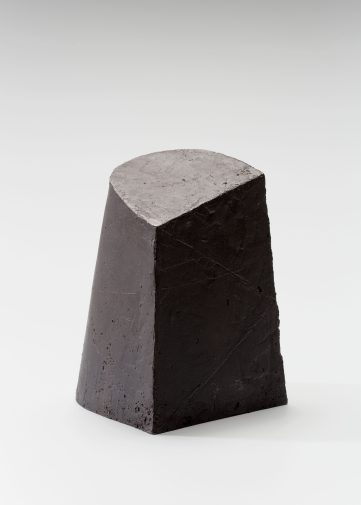
Vladas Urbanavičius (b. 1951)
Sculpture No 2, 1987
Between 1986 and 1988, Vladas Urbanavičius (b. 1951) cast 12 bronze sculptures at his parents’ homestead at Pašiaušė. Without giving them specific titles, he numbered each one, and they all featured in the artist’s inaugural solo exhibition at the LSSR Art Workers’ Palace in Vilnius. Remarkably, with the exception of one piece entitled Leaf, all the sculptures were abstract, a characteristic that left a profound impression on both the public and art critics at the time. The pristine, unadorned sculptures, devoid of any direct associations with tangible objects, caught the attention of Alfonsas Andriuškevičius, the best-known art critic of the time. His review ‘The Quiet Life of Entities’ resonated throughout the cultural community, with his apt naming of the sculptures as ‘entities’, and his assessment of Urbanavičius’ work lending credence to the artist’s exceptional status. These sculptures were shown in Urbanavičius’ inaugural solo exhibition at the Art Workers’ Palace of the LSSR in Vilnius in 1988, as well as in ‘Human Signs’, one of the era’s pioneering conceptual exhibitions, held at the Klaipėda Exhibition Hall in the same year.
Text author Jurgita Ludavičienė
Views of the exposition
Material
Material is the second essential aspect in experiencing sculpture — inseparable from space and equally fundamental. It gives sculpture its authenticity; even etymologically, matter stems from mater, Latin for mother — material is the mother of sculpture. The truth to the material, or fidelity to it, underscores its importance: it can be resisted, rejected, concealed, or even destroyed, but never ignored. Sculptors always have a unique relationship with their materials. This exhibition explores materiality through three key categories: stone, wood, and the once-considered “auxiliary materials” — plaster, chamotte, terracotta, and plastic.
Chamotte, Terracotta, Plaster, and Other Materials
Beyond stone, wood, and metal, sculpture embraces a wide array of materials that broaden its potential – among them concrete, plastic, and materials once considered merely auxiliary: chamotte, terracotta, and plaster. Plaster, in particular, has a long and essential history. Used for casting sculptural forms since ancient Egyptian times, it remains a cornerstone of art education today, with plaster casts of classical sculptures forming a key part of academic training. In the 20th century, as material hierarchies dissolved, these so-called secondary materials gained new artistic autonomy. Clay, concrete, and plaster began to be seen as legitimate sculptural media in their own right.
Sculptors, once using clay solely to shape preliminary models, sometimes treat it as the final material. Concrete and plastic entered the public realm, while plaster — once limited to the classroom — became a springboard for contemporary art practices. The exhibition features a range of works from classical small-scale sculptures and modernist pieces by Lithuanian masters to Standard Reservoirs, a large-scale public sculpture by Vladas Urbanavičius.
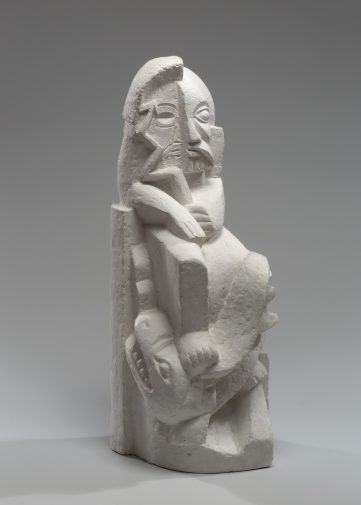
Juozas Mikėnas (1901–1964)
God Perkūnas, before 1931
Juozas Mikėnas (1901–1964) was a trailblazer in modern sculpture in Lithuania, a controversial artist, renowned for his sculptural allegories of Classical forms. Works such as Christ in Distress, The First Swallows and Lithuania remain some of the most widely reproduced pieces of Lithuanian sculpture to this day. The term ‘school of Mikėnas’, originating from the Soviet era, refers to figures characterised by their Neoclassical style and recognisable type, with a robust stature, broad shoulders, a sturdy neck and a broad face, with a straight nose and an open forehead. However, this classification does not fully encapsulate his artistic range. During his formative years, particularly while he was studying in Paris, Mikėnas drew his inspiration not only from Classical art, but also from modern movements. He studied in Paris twice, in 1926 and 1927, and after a brief return to Kaunas, from 1928 to 1931, driven by the determination to attain a diploma of higher education in France. During his first stay in Paris he studied under the Post-Cubist painter and sculptor André Lhote. The sculpture God Perkūnas, exhibiting the clear influence of Cubism, probably dates from his Parisian period. Despite the complexity of its ‘broken’ form, which is typical of Cubism, the sculpture retains Mikėnas’ hallmark monumentality. Formally, it bears a resemblance to works such as Jacques Lipchitz’s The Reader from a few years earlier, or Henri Laurens’ Head of a Boxer.
Text author Jurgita Ludavičienė
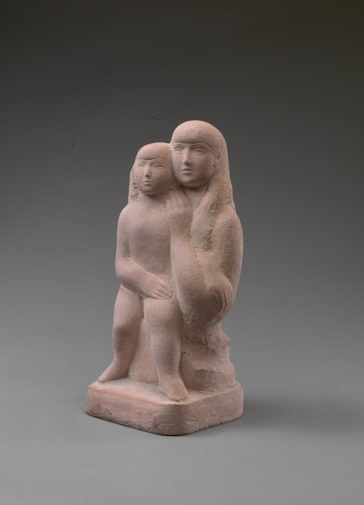
William Zorach (1887–1966)
Motherhood, 1922–1942
William Zorach (Zorach Garfinkel, 1887–1966) was an artist of Litvak origin, born in Jurbarkas, who migrated to the USA with his family in his childhood. He pursued his painting studies at the Cleveland Institute of Art and in Paris. In 1917 he put aside oil painting and took up sculpture. Despite achieving early success as a Modernist painter, participating in the renowned Armory Show in the USA, after 1922 he shifted his focus entirely to sculpture. Employing the direct carving method, he eschewed small-scale models, and carved his sculptures directly from stone. His work reflects a fusion of elements of Classical and primitive sculpture. Motherhood exemplifies this synthesis, presenting generalised forms depicting a mother and baby nestling closely together. There is a replica of this sculpture in the permanent collection of the Tyler Art Gallery at the State University of New York.
Text author Jurgita Ludavičienė
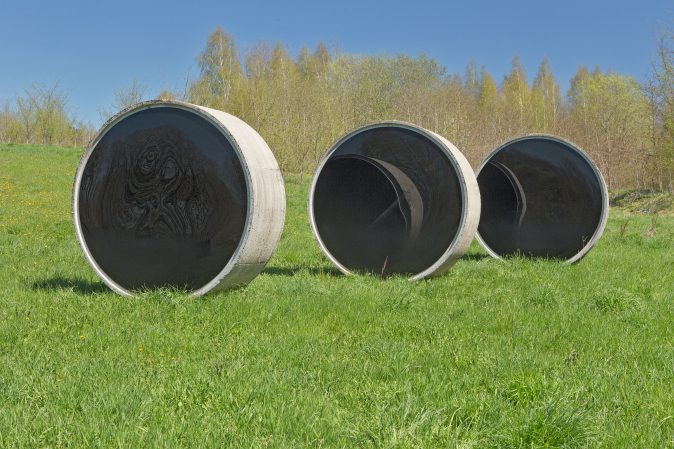
Vladas Urbanavičius (b. 1951)
Standard Reservoirs, 2014
The artwork is comprised of ready-mades: three standard concrete well rings, sealed with black plexiglass sheets. In 2014, the sculptor received an invitation to create a sculptural piece for the inner yard on the ground floor of the Contemporary Art Centre. Placing the well rings in this space integrated them seamlessly with the windows framing the courtyard and with the grey paving slabs. Well known for his environmental sensitivity, Urbanavičius found this combination of objects and the chosen location inherently natural.
However, they appear just as at home in natural landscapes. It is perhaps not a surprise that these sculptures attracted a stork. For several years, the stork circled the well rings, gazing at its own reflection in the plexiglass, and repeatedly trying to peck at it. Its efforts were futile, of course, but the marks left by its beak remain as a subtle testament to the sensitive connection between the sculptures and the natural world. Vladas Urbanavičius (b. 1951) has been working with concrete since 2000, exploring it as a more cost-effective alternative for his works. This addition expanded his repertoire of materials that were previously deemed ‘non-sculptural’. Rather than manipulating the primary and secondary meanings of objects, he focuses on extracting the form. As the art critic Giedrė Jankevičiūtė says, he removes objects from their original context, granting them a new existence. This transformation is evident in his reservoirs. Stripped of their original purpose, the concrete well rings now confront the viewer with ‘eyes’ crafted from black plexiglass. It is as though an abyss is gazing back, offering only a dim reflection of the viewer.
Text author Jurgita Ludavičienė
Views of the exposition
Wood
Wood offers a unique versatility: it allows for realistic depiction, can be polished to a shine, textured to resemble wrinkles or indentations, or shaped into abstract expressions. Even when its forms remain recognizable, wood can serve as a metaphor – an approach embraced by many Lithuanian sculptors in the late 20th century. The resurgence of interest in folk wooden sculpture gained momentum during the Sąjūdis movement, as the ethnocultural revival brought a renewed focus on heritage, identity, and roots, leading to a fascination with ethnographic relics — household tools, farming implements — and the technique of folk carving that was adapted into abstract, non-figurative sculptural forms.
This exhibition section showcases wooden sculptures by both Lithuanian and expatriate artists. The panorama of wood is expressed through a variety of species, from quebracho and mahogany to linden, and through contrasting surface treatments and stylistic interpretations — from folk traditions to modernist approaches. The section culminates in a contemporary conceptual work, where a wooden object becomes an inseparable part of a video installation.
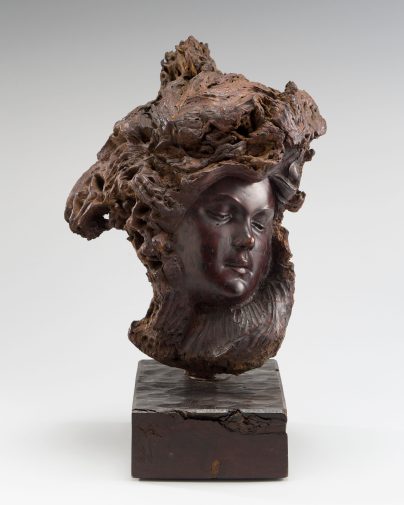
Matas Menčinskas (1897–1942)
Head, 1929-1934
Matas Menčinskas (1897–1942), a sculptor who worked in Lithuania in the interwar years, stood out clearly with his original style. He enrolled at Kaunas Art School in 1922 before the sculpture studio opened there, and soon started to look for opportunities to study abroad. He eventually went to Barcelona, Madrid and Buenos Aires, where he became interested in the work of Stepan Erzia, a sculptor of Mordovian origin, which had a direct influence on his style and on his choice of material (such as quebracho wood). Menčinskas began carving symbolic compositions and sculptures, mostly busts. Financial hardship and failing health made him return to Lithuania in 1934. His unusual pieces carved out of wood are distinguished by their technical skill and expressive power, which were untypical of local sculptors in the 1930s, who worked mainly in clay, gypsum and bronze. However, he did not avoid the influence of Art Deco either, and created figures in Neoclassical forms, as well as high-quality salon-style compositions in gypsum.
Text authors Dovilė Barcytė and Ieva Burbaitė
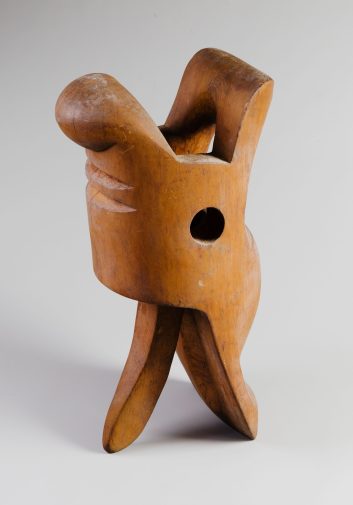
Antanas Mončys (1921–1993)
Erotica, 1968
Wood was an essential material for Antanas Mončys (1921–1993). In his sculptures, he not only developed his concept of the figure, but also fundamentally renewed his language of forms. While creating generalised, refined forms, he sought to retain a trace of remade nature; the motifs and associations that inspired him are recognisable in his work. In Mončys’ sculptures, both the volume of the wood or stone and the void are significant. In a sense, cavities become negative volumes and integral parts of the sculpture. Paraphrasing elements from his childhood, he retains traces of rural culture, while simultaneously creating modern sculptures. His wooden sculptures, inspired by Lithuanian folk art, such as chains hanging from distaffs, marked a new, vibrant and fruitful phase in his work. His chain sculptures, described as ‘vital’ by the art critic Viktoras Liutkus, reflect nature as their true home. Thus, Mončys’ wooden sculptures encompass a broad range of forms, symbolising life, vitality and abundance. These sculptures embody femininity, and, of course, eroticism. His eroticism is often tinged with a hint of irony or a smile, such as two figures from a single tree trunk fused together in an embrace, or chains clinging to each other (1968, Antanas Mončys Museum), where the male attribute is clearly recognisable.
Text author Jurgita Ludavičienė
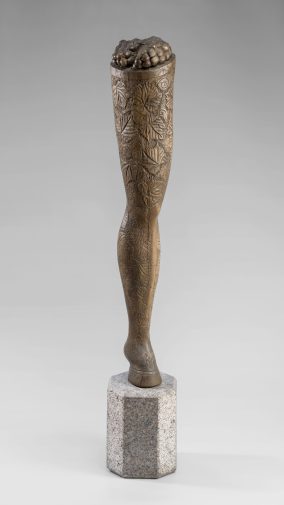
Šarūnas Šimulynas (1939–1999)
The Leg of a Woman Who has Slipped, 1992
Šarūnas Šimulynas (1939–1999) stands out as an exceptional figure in Lithuanian sculpture. Known for his solitary nature, Šimulynas often embarked on solitary journeys to remote and harsh places, such as the taiga. His work was profoundly influenced by a trip to Australia, and by his stay on the uninhabited St Bees Island, fulfilling a long-held dream. Despite his preference for solitude in real life, Šimulynas’ art reveals a deep interest in people. The human figure frequently appears in his work, characterised by elongated limbs and stylised forms with small heads, depicted in various poses, grappling, resting and waiting.
This sculpture, a part of a leg, has clear erotic undertones. This aspect perhaps displeased the sculptor’s wife, who urged him to sell it as quickly as possible. He complied at the first opportunity. However, after the sculpture left their home, the erotic leg reappeared in a drawing. The piece is imbued with mischievous irony, suggested by its title, The Leg of a Woman Who has Slipped, hinting at a tempted or fallen woman. Intriguingly, the leg ends in a hoof, and begins with a bunch of grapes and leaves, evoking Dionysian associations. This leads to the question: could it be the leg of a satyr that seduced a woman?
Text author Jurgita Ludavičienė
Views of the exposition
Stone
Stone sculpture is timeless – it speaks to us most clearly of eternity. As the material closest to us and least affected by time, stone stirs the imagination with its permanence. Sculptors work with a wide range of stones, from soft sandstone and limestone to marble and granite — their most formidable rival. Stone is self-sufficient; it radiates strength, constancy, and monumentality. When polished, it reveals a hidden inner texture; left rough, it speaks through its surface, where moss may cling and become part of the work itself.
Stone is also the prison from which sculpture must be freed — an idea known since Michelangelo. It is a material to wrestle with, an opponent that demands struggle to be shaped by the artist’s will. Yet stone is not always an adversary or keeper of trapped form; it is one of sculpture’s most cherished materials. Beyond its physical properties, stone carries a kind of agency — a force capable of affecting its surroundings. Just like Teeth, Mindaugas Navakas’s granite sculpture designed for public space. This section showcases works that reflect Lithuanian sculptors’ evolving relationship with stone: from realistic portraits to abstractions, from classical marble to conceptual forms.
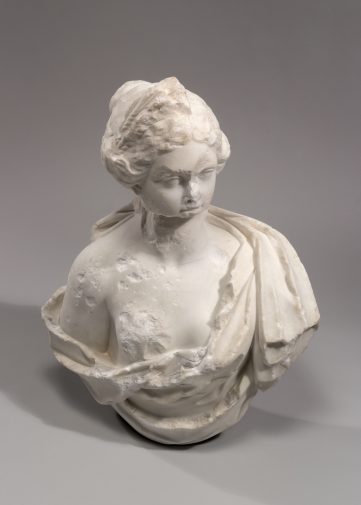
Unknown artist
Summer, ca 1900
The theme of the seasons has been prominent and easily recognisable in European fine art ever since Classical Antiquity. In Ancient Greek mythology, the seasons were personified by the daughters of Hora, Zeus and Themis, usually portrayed as young women adorned with seasonal elements, such as spring flowers, ears of corn, fruit, and the bare branches of trees. These women symbolised the eternal cycle of nature, to which all living things are subject: birth, growth, maturity and death, followed each time by rebirth. Summer, or the Golden Hora, was depicted with a crown made of ears of corn, embodying the patroness of plants, growth and fertility. This bust of Summer, created in 1900, once stood on a concrete pedestal on the east side of the southern parterre at Užutrakis manor, which belonged to the Tyszkiewicz family. It was part of an Antique-style sculptural group called The Seasons. Unfortunately, the sculptures were destroyed after the Second World War and replaced by monuments devoted to Soviet ideological leaders. In 2019, the Directorate of the Trakai National Park initiated the restoration of the manor’s sculptures. A replica of the bust Summer, sculpted and cast from artificial marble, now adorns Užutrakis Park. Although the other sculptures on the main parterre of the park were created by the 18th-century French sculptor Antoine Coysevox, this appears to be an exception.
Text author Jurgita Ludavičienė
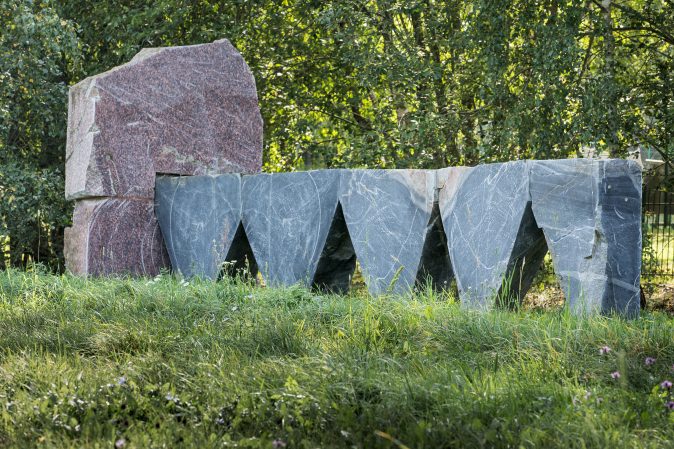
Mindaugas Navakas (b. 1952)
Teeth 2, 2015
In a 1992 interview with Ramutė Rachlevičiūtė, Mindaugas Navakas (b. 1952) said that size is one of the fundamental elements shaping the structure of the Universe. Three years later, Kęstutis Kuizinas, the director of the Contemporary Art Centre, remarked that Navakas’ sculptures are not merely large, they are always slightly oversize. This observation aptly captures the monumental quality of Navakas’ granite sculptures, which exude an almost overwhelming force. Massive triangles, standing almost eight metres high and thrust into the ground, evoke the image of dragon’s teeth, like those sown by Jason in his quest for the Golden Fleece, from which armed warriors sprang forth. While this cultural association may arise involuntarily, it probably has little relevance to the sculptor himself. Navakas is driven by a quest for power rather than aesthetics. His sculptures emanate a force and a vitality that compelled him to confront the challenges of working with granite, effectively eschewing the decorative tendencies prevalent in the 1980s. He once remarked: ‘Encountering the material, i.e. granite, had a profound effect on me. I can’t explain why I was drawn to it. I appreciated its hardness. The challenge it presented in subduing it. Somehow, I liked the challenge.’* This ongoing confrontation with granite, his eternal rival, serves as a constant reminder of his own power, with stones of varying colours, split and with uneven edges, serving as tangible remnants of the struggle, akin to relics on a battlefield.
Text author Jurgita Ludavičienė
* From a conversation with Deimantas Narkevičius, Vilnius, CAC, 2001, pp. 10–12.
Views of the exposition
Mindaugas Navakas „Shelter K“ (1995)
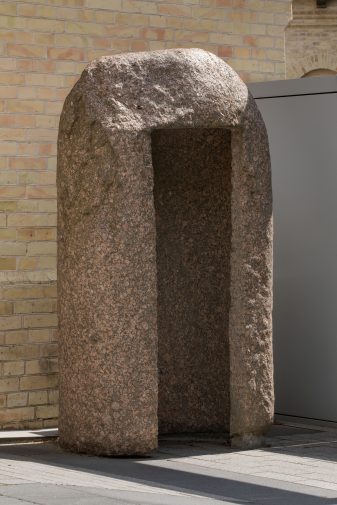
This work was shown at the inaugural Gwangju Biennale ‘Beyond the Borders’ in South Korea in 1995 as part of the East and Central European Collection. It subsequently featured in 2015 in Vilnius in Mindaugas Navakas’ (b. 1952) comprehensive exhibition ‘Glory Was at the Fingertips’ at the National Gallery of Art. Its presentation at the Gwangju Biennale was particularly significant in the context of Lithuania’s early period of independence, given the Biennale’s theme of globality and the transcending of differences in ideology, territory, religion, race, culture and art, with 87 artists from 49 countries participating. Anda Rotenberg, the curator of the East and Central European collection, described Navakas’ work as emblematic of the Lithuanian identity. ‘Yet it is first of all the boulder itself that is a work of art, not the niche. It is the boulder with its weight, size, structure, that is the artist’s message. Otherwise, given the problems and transport costs, it would not have been sent as far as Korea, where it was to represent not only the creator’s person, but Lithuania itself. The heaven for a body, carved in stone is the obverse of the medal that on its reverse has the Mickiewiczian “painted fields” and “marshes” of Konwicki, Milosz’s mystical valley of the Issa and the tall banks of the Nieman by Orzeszkowa. Just like them, Navakas has his two feet on the ground, but he reaches deeper, for the essence and the substance. He struggles through the cultural layers, including the layer of the agrarian culture.’* Expanding on Rotenberg’s interpretation, Navakas’ Shelter K invites viewers to delve into the core of the Lithuanian identity and culture. Regardless of their location, whether they are in South Korea or Lithuania, viewers, particularly those of a similar build to the sculptor, physically engage with the stone by filling the cavity with their body, tangibly connecting with the stone and the content it embodies.
Text author Jurgita Ludavičienė
* Rottenberg A. Why does something catch your eye. Mindaugas Navakas /R-O/ Works. Museum Rzezby Wspolczesniej, Oronsku, 2006, p. 17–18.
Views of the exposition
Dream
The third (deceptive) element: contemporary sculpture. These works use traditional sculptural materials and forms, but transform them in ways that challenge our perception. They deceive the eye, altering our sense of reality. While recognition remains, the solidity, stability, and constancy we expect from sculpture disappear. In these works, materials change their properties, and forms shift in proportions — creating a sense of uncertainty, where viewers can no longer rely on their knowledge. Contemporary sculpture imitates traditional materials and methods, but twists them. Familiar laws no longer apply, making it impossible to interpret a work logically.
Here, stones are not made of stone, pipes hum, evoking a threatening futurity, and the human form distorts. Folk sculpture converses with contemporary works, while painting also contributes to creating a strange, uncomfortable, dreamlike atmosphere. We enter a realm of intuition, emotions, and experience, where rational knowledge has no place. In this space, we step into the shadow, the subconscious, the dream. A dream cannot be explained by knowledge alone; its logic is different. We read a book written in an unfamiliar language, thinking we understand it — until we wake up.
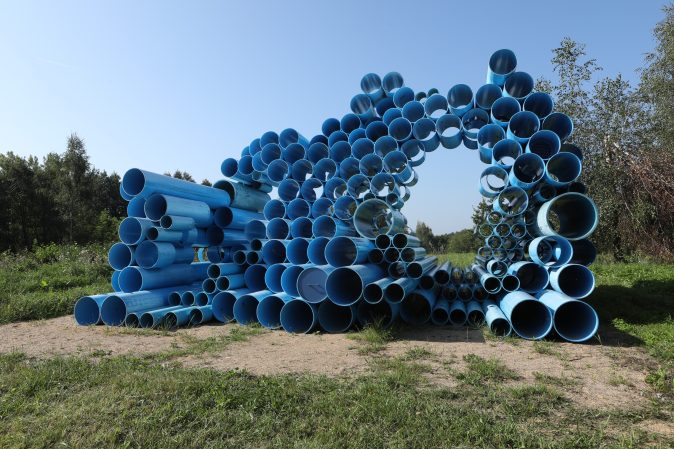
Nomeda (b. 1968) and Gediminas (b. 1966) Urbonas
Futurity Island, 2018
Nomeda and Gediminas Urbonas (b. 1968 and 1966) are an artist duo who are consistently engaged in research-based artistic creation. Each of their works emerges from extensive, often long-term, research across various fields, seamlessly blending scientific and artistic endeavours. Having graduated from the Vilnius Academy of Art in different disciplines (Nomeda in graphic art, Gediminas in sculpture), they initially pursued solo careers. Gediminas was a founding member of the pioneering Žalias lapas (Green Leaf ) performance and action group in 1993. Together with the art researcher Saulius Grigoravičius, he established the Jutempus TMP (Interdisciplinary Art Projects) contemporary art gallery in what is now the Kablys venue. In 2007, the Urbonas represented Lithuania at the Venice Biennale with their interdisciplinary project Villa Lituania. This project can be viewed as an artistic exploration of the former Lithuanian Embassy building in Rome, which Lithuania lost after its occupation by the Soviet Union. Currently teaching at the Massachusetts Institute of Technology, the Urbonas focus predominantly on ecological themes in their work. Their installation Futurity Island exemplifies this interest. It serves as an object firing the imagination, a stage for performance, and a space for listening. At its core lies a large-diameter pipe, clearly crafted by human hands. Yet it transcends its industrial origins, which are typically associated with drainage, and oil and gas pipelines, as part of man’s exploitation of nature. In the Urbonas’ vision, the pipe transforms into a tool for listening to the sounds of nature, serving as a conduit to reveal its secrets. Futurity Island offers the hope of a harmonious coexistence between man and nature. Originally conceived as a floating laboratory for the Venice Biennale of Architecture, the installation debuted in 2018 at ‘The Work of Wind: Land, Air and Sea’ project organised by the University of Toronto. In 2019 it graced the square of the Massachusetts Institute of Technology campus, and in 2023 it was exhibited at the National Gallery of Art in Vilnius.
Text author Jurgita Ludavičienė
Nicole L’Huillier. Amphibian Songs, 2019
Views of the exposition